PRAE EDITORIAL · VOLUME 01
The Case for Courtyard Living
Across climates and centuries, courtyard houses have turned exposure into intimacy. Contemporary versions remain compelling because they organize experience before they organize style.

WRITTEN FOR PRAE BY
Thomas Vale
Design Correspondent
PUBLISHED
7 min read
The courtyard is not empty space. It is an outdoor room that edits climate, privacy and the social life around it.
An outside room with edges
A terrace belongs to a façade; a courtyard belongs to the plan. Because it is enclosed on several sides, it can shape circulation, bring light into deep rooms and establish a private orientation even on an exposed site. Its value comes from the relationship between interior and exterior, not from the size of the open space alone.
The strongest courtyards have a clear role. One may hold arrival and make the threshold gradual. Another may support meals, play and daily movement. A smaller court may bring morning light to a bath or give a guest room a protected outlook. Treating every court as a decorative garden wastes its architectural potential.
Climate becomes visible
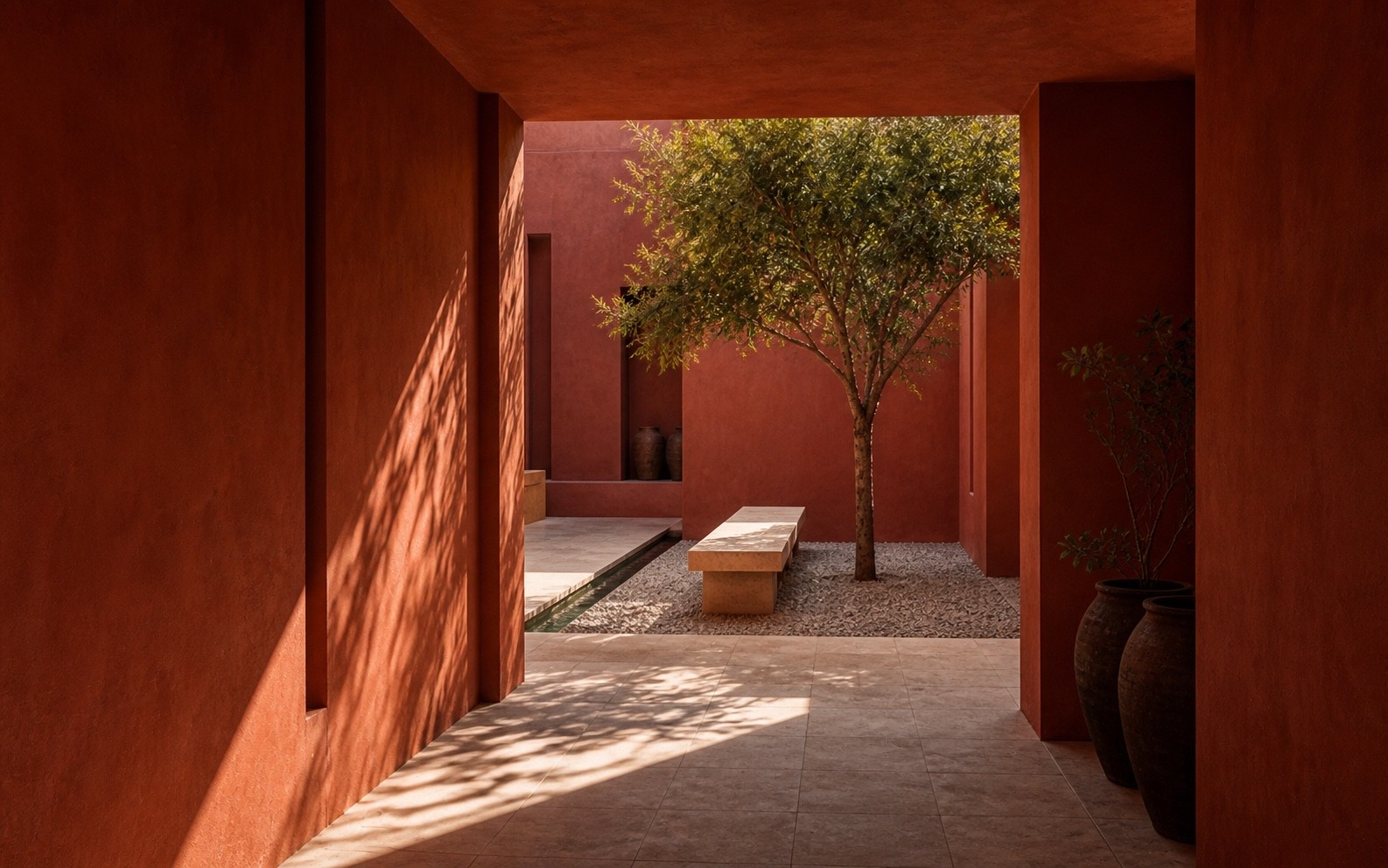
Courtyards can slow wind, provide shade and create pressure differences that encourage ventilation. Water and planting may cool air locally, while thick walls store the temperature of the night. These effects depend on orientation, proportion and local climate; a diagram copied from another latitude can easily make conditions worse.
When calibrated well, environmental performance becomes part of the experience. A line of shade moves across a wall, leaves stir before air reaches the room and a narrow water channel marks the direction of flow. Comfort is not hidden inside equipment. It is made legible.
Privacy without withdrawal
An inward-looking house is sometimes mistaken for a closed one. In practice, a court can make openness easier. Large doors can remain open without exposing the interior to the street or prevailing weather. Rooms on opposite sides maintain visual connection while preserving acoustic and functional distance.
This is particularly useful for multigenerational homes and properties that move between intimate and extended occupancy. Doors, screens and planting can adjust the degree of connection without changing the underlying plan.
The social centre is unprogrammed
The best courtyard is rarely overdesigned. It supports a table, a tree, a patch of sun or an evening gathering without insisting on one use. Its relative emptiness gives the surrounding rooms a shared centre and allows the household to invent rituals over time.
That adaptability explains the courtyard's enduring relevance. It is simultaneously practical and poetic, climatic and social. More than a visual motif, it is a way of making a home feel complete around a piece of sky.
Thomas Vale
Design Correspondent
CONTINUE READING